
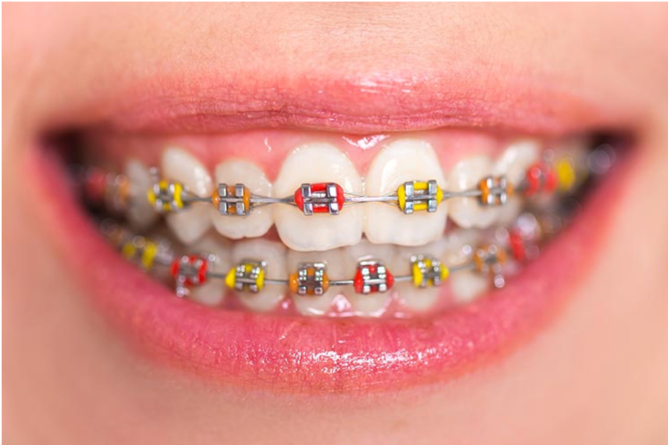
Dental
Braces
Tamzid Rahman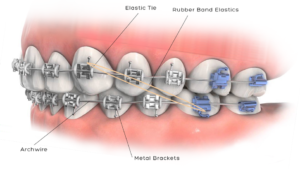
Writing for Engineers
Technical Description
March 08, 2019
Introduction
“Say Cheese!” Many people are insecure about their teeth. Braces are devices used on orthodontic. That make even and straighten teeth and help position them. The braces is connected to a person’s bite, while improving dental health. Some of the benefits for using braces, are to align the teeth to be straight, helps with digestion and gain space for eruption permanent tooth. The inventor of braces is no other than Pierre Fauchard, who is the founder of modern orthodontics in the 18th and 19th century. Pierre founded the proper way for straightening teeth and wrote a book called “The Surgeon Dentist,” which gave him a title called The inventor of modern Orthodontics.
Main Body
There are six main parts that make up this invention: elastics, arch wire, brackets, coil spring forus spring and hooks
The elastics are tiny rubber bands that fit around the finger on the bracket. The elastics are engaged to the wire that each are a slot on each bracket. Elastics can be either colored (plastics), metallic (silver) or clear to match with the brackets and can be changed at each arch wire installation.
The Arch wire is the main wire that is fitted across the upper and lower Jaw. Some of the wires are used for a memory cushion. The memory can be bent and twisted by the orthodontist so it can fir the slot of the bracket. Over a period of time, the wires return to their remembered position, as the pressure moves the teeth
The brackets may be glued or engaged directly to each tooth or to a band. They hold the arch wire together so that each tooth are fitted one to the another. The arch wire fits into a slot for each of the brackets so it can hold in its place.
The coil spring slides over the arch wire and fits in its place. It is used to push the two brackets apart ,hence creates space between two teeth at the same jaw.
The rubber bands assists the arch wire in the closing spaces and bring the upper and lower jaw together. It is fitted by a hook onto a bracket in the upper jaw and later stretched to fit against a bracket in the lower jaw.
The forus Spring are springs that are attached on the left and the right side of the jaws. They are connected to the upper backs of the molar to a lower side of an arch wire. Afterwards, they are pushed against to the upper molars and forming a backward alignment.
The hooks are small accessories on the selected brackets on the upper and lower parts of the jaw. They are used to attach with the rubber bands.
Why do we need Braces?
The reason that we need braces because of the following
- It helps to align the teeth to be straight
- Prevents tooth decay
- Gain space for the eruption of permeant teeth
- Helps for your digestion
- Prevents Cavities[1]
Many dentists recommend that the braces can progress the patient’s “orofacial” appearance, meaning that they want the face to look in a great look or character. The orthodontic treatment, with the problems like bent. not straight or overcrowded teeth, overbites, underbites and dislocated jaw position.
How can you tell that you need braces?
An adult can be easier to tell whether or not that they should get braces, on the contrast a child is harder to tell whether or not if they have an underbite or an overbite. According to the Stanford’s Children Health, here is some things that you need to watch out such as late, early or irregular loss of bath teeth, difficulty biting or chewing, misplaced, crowded or blocked-out teeth. Furthermore, the Stanford’s children Health stated, “Children should have a checkup with an orthodontist no later than age 7. Your regular dentist is an excellent resource who can tell you whether your child, regardless of age, would benefit from seeing an orthodontist.” This corresponds to the fact that having regular checkup can spontaneously help the child’s teeth to nurture properly.
In America majority of the children have braces, unlike some different places of the world adults are used more often. According to the Washington Post, it is stated “An estimated 4.5 million Americans — most of them children and teenagers — wear braces on their teeth, according to the American Association of Orthodontics. About 80 percent of those undergoing orthodontic treatment range in age from 6 to 18 years old.” This is true unlike countries such as England have adults wearing braces, anecdote by Tessa Evelagh from The Guardian, “Tessa Evelagh, 52, got braces when she was 49. “It was the best thing I ever did,” she says.” Dr. Chatoo said in The Guardian, “ “and we have more and more adults becoming interested. I mainly used to see younger adults, from 20 to 35; now the patients I see can be over 50.” Often times the orthodontic treatment is indicated in order to recondition function, preserve health, assist speech, protect teeth from distress, and recover aesthetics.
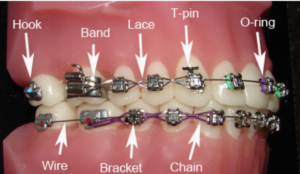
Anatomy of the Braces:
Figure 2
The Pros and Cons about Braces
Pros:
- Healthier looking teeth
- Helps your self- esteem
- Jaw alignment
- Helping speech problems
- Better bite (Digestion)
Cons:
- Costs a lot of money
- There are certain foods that you cannot eat
- Sometime lowers the self-esteem (bullying)
- Extra cleaning care
- Many gadgets in the mouth
- It takes time for the braces to straighten the teeth
How do Braces Work?
Braces work by applying continuous pressure over a period of time, by slowly moving the teeth in a different direction. The teeth moves, while the bone of changes it shape, as the pressure is being applied.
Different Types of Braces
- Dental Braces (Metal Braces)
- Ceramic Braces (Clear braces)
- Self-Ligating Braces
- Invisalign
Conclusion
When you put all of the braces together, it creates one invention that protects the teeth. Braces are meant to help your teeth being straight from aesthetics to chewing food properly. Braces are used by everyday people, to help straighten their teeth and for looking their best. Braces are commonly used for children in the United States. While in contrast, other countries have adults used more often. Braces have made a huge impact on our society. The effects had changed hundreds of life and every day by giving the patients a healthier appeal to the mouth and right care. The significance of braces is to give the teeth a healthier look and help crowded teeth to align properly.
Work Cited
“The Orthoevolution of Orthodontic Archwires – Orthodontic Products”. Orthodontic Products. Retrieved 2016-10-30.
Copyright © 2019 align Orthodontics
Figure 1: https://www.goldreichorthodontics.com/emergency-care
Figure 2: https://morganorthodontics.com/the-anatomy-of-braces/
The Guardian
https://www.theguardian.com/lifeandstyle/2008/feb/28/healthandwellbeing.eminesaner
2008-02-28
[1] Not all of the time, even if a person eats a lot of sugary food it will be hard for them to brush their teeth from the area of the tooth.

This entry is licensed under a Creative Commons Attribution-NonCommercial-ShareAlike 4.0 International license.

